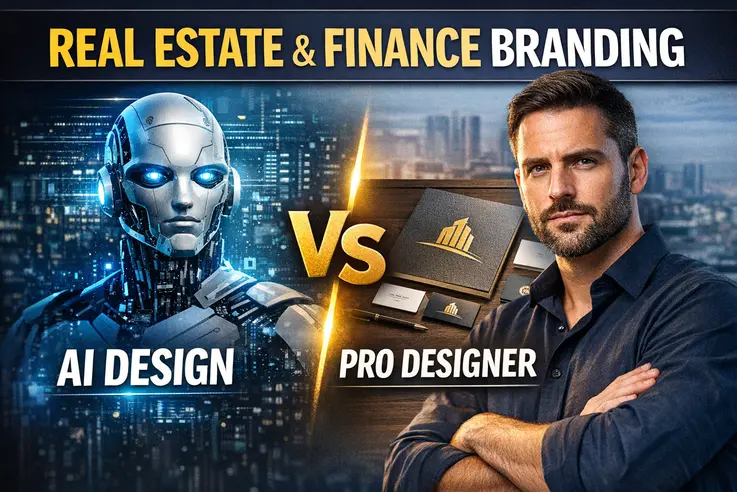
AI in Design: Why Real Estate and Finance Brands Still Need Human Logo Designers

Lately, I’ve been noticing the rise of AI in design — not just the technology itself, but the commentary surrounding it. I’ve spoken about AI before on my blog and on Medium, but here in Barbados one trend has really stood out: businesses using AI‑generated posters for their social media. The strange thing is, they all look the same. I’m not sure what prompts these businesses are feeding into the AI, but whatever it is, the results are repetitive, soulless, and instantly recognizable as machine‑made. People have started criticizing these posters, saying the businesses should just pay a designer. And honestly, they’re right.
Now, it may surprise you, but I’m not against AI. I believe AI can be a useful helper if used responsibly. I don’t use it for design work or creative ideas — I use it for research. But I don’t believe AI is a replacement for designers. At best, it can generate possible directions or spark inspiration. The problem with substituting AI for an actual designer is that the algorithm tends to produce the same kind of output over and over, without much thought or originality. I’ve tested AI logo generators myself. If you ask them to create 100 logos, you’ll get 100 generic marks that look like they were scraped from the internet. None of them would be usable, none of them would be better than what a trained designer could create, and legally speaking, none of them would be something a brand could truly own. If everyone relied on these generators, every brand would end up with the same disposable garbage.
I’ve seen videos of advanced AI systems creating full brand identity systems. Visually, they weren’t terrible. But design isn’t just about how something looks — it’s about how it works. As I’ve said before, the difference between art and design is function. Art is meant to be seen; design is meant to be used. For a logo or identity to be functional, it has to pass certain tests: is it appropriate for the industry, is it scalable, does it align with the market, does it send the right message to the audience, is it timeless enough to build recognition over years? AI doesn’t ask those questions. It doesn’t understand nuance, purpose, differentiation, history, culture, or human response. It lacks taste. Even when the visuals are striking, they lack soul.
To play devil’s advocate, AI isn’t that different from many so‑called “designers” today. Too many people think knowing how to use a computer program makes them a designer. They churn out work without thought, just like AI. When I saw people criticizing the AI posters used by party promoters here in Barbados, I agreed, but I also thought: nothing has really changed. Those posters were always cheap, overly designed, full of effects, shouting at the viewer. Whether human‑made or AI‑made, the design approach was the same. But when more serious brands — especially in real estate and finance — start using AI in that same careless way, that’s when the real damage happens. That’s when brand recognition erodes and identity collapses.
I know many designers and artists worry about an AI takeover, where jobs vanish and robots dominate. In my opinion, AI will simply become another tool, just like the camera once was. When cameras replaced painted portraits, artists didn’t disappear. The demand shifted, but people still commission portraits today. The same will happen with design. The industry will change, but there will always be a need for humans who understand fundamentals.
Some argue that AI will wipe out entry‑level design jobs, as small businesses opt for cheaper options. But how is that different from when Canva arrived? Canva allowed anyone to make templated posters. Was the output good? No. Because a designer wasn’t using the tool — just a random business owner. A trained designer is still needed to ensure quality, to bring taste, to understand fundamentals. Canva required manual input, while AI requires only a few words, but the principle is the same: without design knowledge, the result is shallow.
Even if a business owner thinks the AI output is “good enough for now,” it will cost them later. They’ll realize their identity doesn’t scale, doesn’t differentiate, doesn’t build trust. That’s when they’ll turn to a professional. And that’s why, despite AI being available for years, I still get leads in my inbox. Because design isn’t about making something pretty. It’s about creating something that works. Real estate and finance brands in the UK, US, and Barbados understand this. They know their logo is a business asset, not a decoration. They know that investing in a designer means investing in authority, credibility, and long‑term recognition.
AI will continue to evolve, and it may even open new career paths. But it will never replace the role of the designer in building brands that last. My advice to any designer is simple: learn what design actually means, and master it. Because serious brands — especially in real estate and finance — will always need human creativity, strategy, and taste to stand apart in competitive markets. If you’re ready to build your Real Estate or Finance brand today, Contact Us